

A pilot never feels altitude. At 30,000 feet, the air outside the cockpit looks the same as it does at 3,000. Without instruments, a slow descent is invisible until the ground is suddenly very close. Careers work the same way. Nobody wakes up and feels stagnant. It creeps in one comfortable, uneventful month at a time until you look up and realize you have been circling the same altitude for years while people around you climbed. That is what a career growth audit is for: a deliberate, honest instrument check. Not a panic response to a bad week, but a periodic reading of your actual trajectory versus the one you assume you are on. Here are five signs your gauges need checking.
- You have stopped noticing “firsts”: Growth leaves a trail of firsts; first time leading a project, first time in a room you were not invited to before, first skill you had to Google at 11pm. If you cannot remember your last “first,” you are not failing. You are cruising. And cruising, indefinitely, is how careers quietly stall at altitude.
- You hear about opportunities after they have closed: The promotion got filled. The project got staffed. The reorganisation happened. And you find out via calendar invite, not conversation. This is not bad luck; it is a visibility problem. Being good at your job and being *known* for growing in it are two different instruments, and only one of them gets you picked.
- Your skillset is last year’s model: Your role has not changed, but the market around it has. If you could not describe one meaningfully new capability you have built in the past twelve months, your skills are not stagnant, they are depreciating quietly, like currency losing value while it sits still.
- “What is next?” does not have a fast answer: Ask yourself the question a good recruiter would ask in the first five minutes: where does this lead? If the honest answer takes a long pause, a shrug, or a sentence that starts with “well, I guess maybe,” that is not a minor gap. Direction is the flight plan, without it, effort just keeps you airborne, not on course.
- The job still fits, but nothing stretches you: This is the quietest sign and the easiest to mistake for contentment. Comfort is not the enemy. But if nothing in your week creates a flicker of “I am not sure I can do this yet”, you have likely levelled off. Growth requires just enough discomfort to register on the instruments.
None of these signs, alone, is an emergency. But two or three together are exactly the pattern a proper audit is built to catch early while you still have plenty of altitude and options, instead of after you have noticed the ground coming up fast.
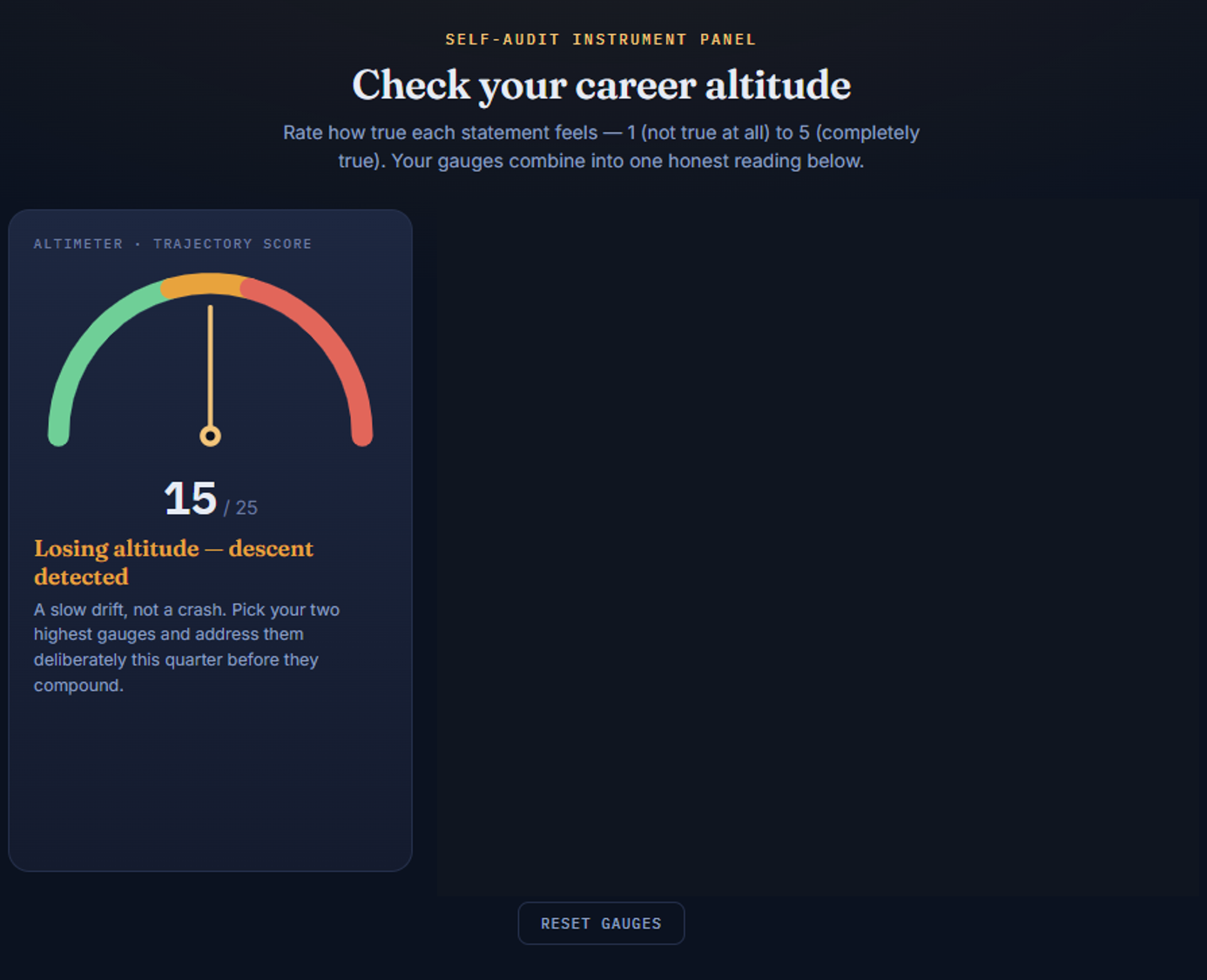
Make use of the self-audit instrument panel: five gauges, five honest readings, one overall trajectory score and a straight-talking verdict on whether you are cruising, drifting, or due for a course correction.

Hello!
I am Olorunfemi Ojomo
HR Strategy | Talent Management | Organisational Development | Organisational Design| Performance Management | Change Management | Analytics