

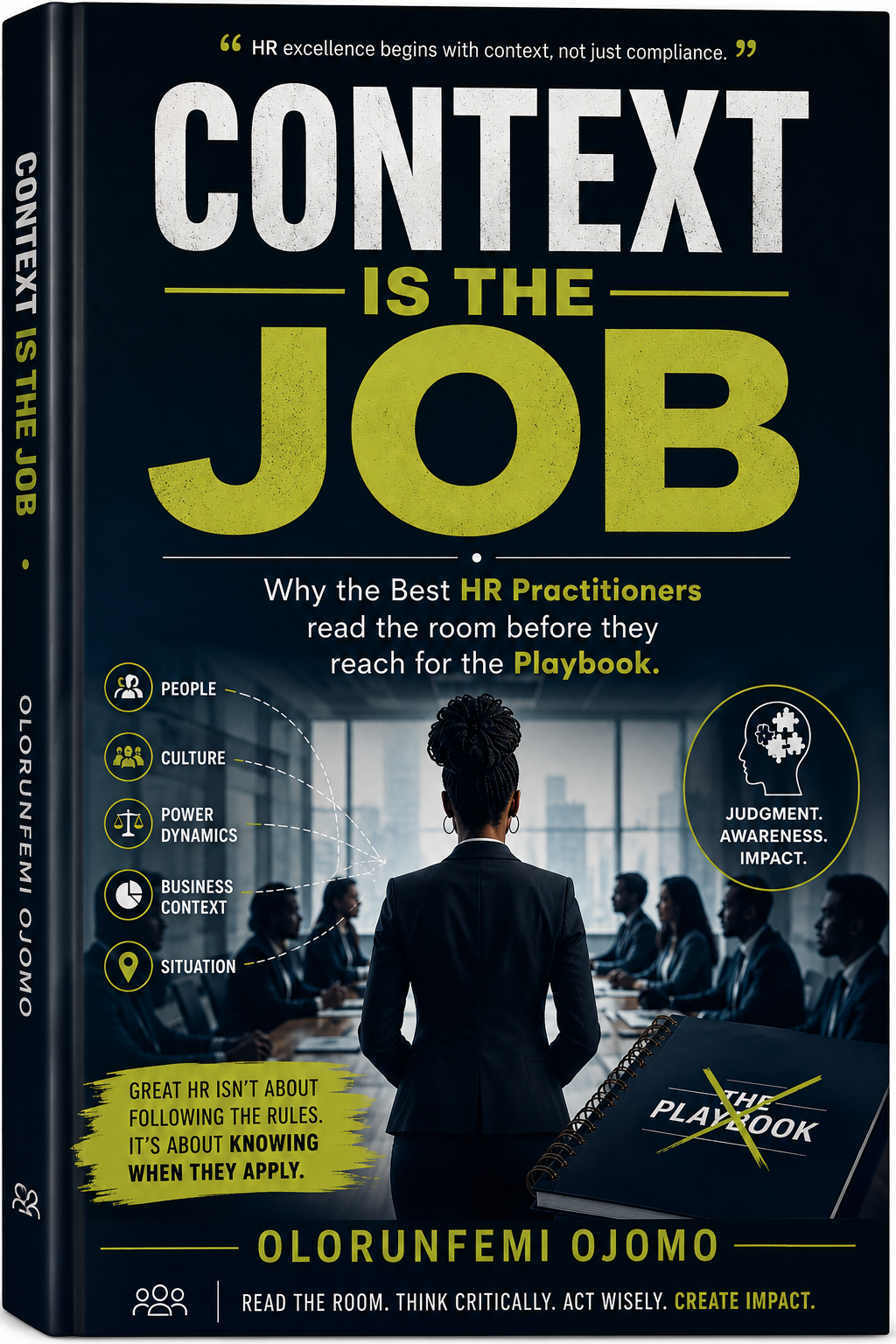
This book came to be after I overheard a senior practitioner trying to pass judgement on the interventions of a young developing practitioner through name dropping of models which is deemed fit as best practice in the subject of discuss without recourse to the context in which the young professional played. This situation has always played out and continually pile up conviction for me to write about it.
There is a list of things we wished someone had told us earlier; it is not about how to run a compensation study or facilitate a values workshop, since those things were covered, thoroughly, by the training and certifications that got us into this field in the first place. It started as a list of the moments, where doing everything by the book still went badly, and where the things that would have actually helped had no name within the league of models and best practices.
Every practitioner reading this have their own version of that list. Some of the situations in this book will be familiar because something close to them happened at a company you worked for. Others will be familiar for a stranger reason: because the shape of the failure matches something you lived through even though none of the surface details do. That’s the pattern this book is trying to name, and if it succeeds at anything, it will be at giving practitioners a shared vocabulary for a kind of judgment most of us have been quietly exercising, unevenly and without much support, for as long as we’ve been doing this work.
This book does not claim to replace the technical foundations of HR practice, and it isn’t meant to. Compensation design, employment law, performance methodology, structured hiring; these remain genuinely necessary, and nothing in the chapters of the book should be read as an argument against rigor in any of them. The argument is narrower and, I’d suggest, more useful than a wholesale critique of the field’s technical core: that rigor in the tool has to be matched by rigor in reading whether, when, and how to use it, and that second kind of rigor has never quite gotten the same attention as the first.
If this book has a single hope for the reader, it’s a modest one. Not that you’ll memorize five letters and a diagnostic checklist, though I hope PACES earns a place in your actual practice. It’s that the next time something technically correct goes quietly wrong, you’ll have a faster route to the real question than most of us had for most of our careers; not “what did I do wrong with the tool,” but “what did I not yet understand about the room.”
That question, asked early enough and honestly enough, is most of the job. The rest, as the closing chapter puts it, is vocabulary.
Chapters in the book are listed below. It promises to be an insightful read.
Table of contents
Prologue: The Room she didn’t read
Part I – The Blind Spot
Chapter 1: The Myth of Best Practice
Chapter 2: Competence isn’t the Problem
Chapter 3: Why HR keeps importing solutions
Part II – The Grammar of Context
Chapter 4: A name for what you already do
Chapter 5: P for Power
Chapter 6: A for Ambient Culture
Chapter 7: C for Conditions
Chapter 8: E for Ego
Chapter 9: S for Stage
Part III – Context in Practice
Chapter 10: Hiring & Selection
Chapter 11: Performance Management
Chapter 12: Compensation & Pay Transparency
Chapter 13: Culture Change & Values Work
Chapter 14: Layoffs & Downsizing
Chapter 15: DEI Programs
Chapter 16: M&A & Integration
Part IV – Becoming Context-Literate
Chapter 17: The Weekly Habit
Chapter 18: Reading the Room in Real Time
Chapter 19: When to break your own rules
Chapter 20: A Closing Case

Hello!
I am Olorunfemi Ojomo
HR Strategy | Talent Management | Organisational Development | Organisational Design| Performance Management | Change Management | Analytics